
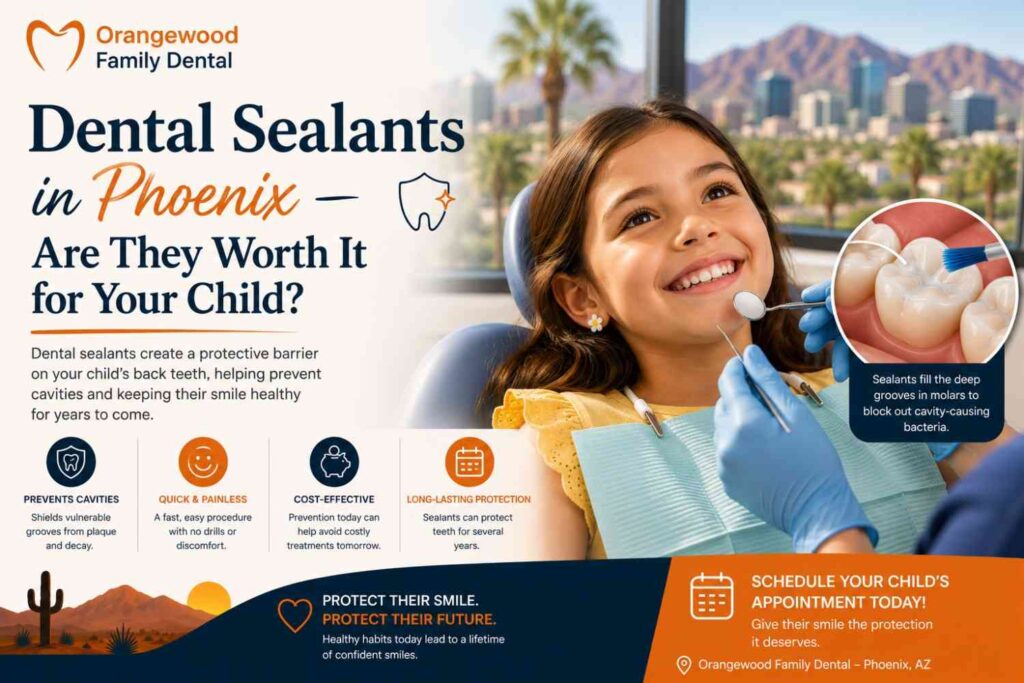
Your child just had their six-year molars come in, and their dentist is recommending sealants. Or maybe you’re an adult who keeps getting cavities in the same back teeth, and someone mentioned sealants might help. Either way, you’re asking the right question before saying yes.
At Orangewood Family Dental, Dr. Fullenkamp has been applying dental sealants for Phoenix families for over 30 years. As a trusted family dentist in Phoenix AZ, his view is straightforward: sealants are one of the most effective and most underused preventive tools in dentistry. But they’re also not right for every tooth — and he’ll tell you honestly which category your child falls into.
This guide covers everything Phoenix AZ parents and patients need to know about dental sealants in Phoenix, how they work, who needs them, what the application looks like, and whether they’re actually worth it.
| Quick Answer Dental sealants are thin protective coatings painted onto the chewing surfaces of back teeth to prevent cavities in deep grooves where brushing can’t reach. The ADA reports sealants prevent up to 80% of cavities in back teeth. They’re most commonly applied to children’s molars around ages 6 and 12, but adults with cavity-prone teeth can benefit too. The process is painless, takes minutes per tooth, and sealants typically last 5–10 years with regular monitoring at Orangewood Family Dental in Phoenix AZ. |
| Table of Contents 1. What Are Dental Sealants? 2. Why Back Teeth Are So Vulnerable — The Science Behind Sealants 3. Who Needs Dental Sealants in Phoenix? 4. Dental Sealants for Children — The Ideal Timeline 5. Dental Sealants for Adults — When They Make Sense 6. Sealants vs. Fluoride — How They Work Together 7. The Application Process — What to Expect 8. How Long Do Dental Sealants Last? 9. Are Dental Sealants Safe? 10. Expert Tips from Dr. Fullenkamp 11. Key Takeaways 12. Frequently Asked Questions 13. Conclusion |
What Are Dental Sealants?
Dental sealants are thin, plastic-based protective coatings — typically made from a resin sealant material — that are painted directly onto the chewing surfaces of the back teeth. Once applied, the liquid flows into the deep grooves and fissures of the tooth and is hardened with a curing light, creating a smooth sealed surface that bacteria and food particles can’t penetrate.
The result is a physical barrier between the tooth surface and the decay-causing bacteria in your mouth. Molar sealants don’t replace brushing and flossing — they work alongside them, protecting the areas that are hardest to clean no matter how diligent you are.
According to the American Dental Association, sealants prevent up to 80% of cavities in the back teeth — the teeth responsible for 90% of all cavities in children. That’s one of the strongest cavity prevention statistics in all of preventive dentistry. You can learn more about the full range of preventive options available to your family through our dental sealants service for children in Phoenix.
Why Back Teeth Are So Vulnerable — The Science Behind Sealants
The chewing surfaces of molars and premolars are covered in deep pits and grooves — called pit and fissure anatomy — that are essential for grinding food. But those same grooves are extremely narrow, sometimes narrower than a single toothbrush bristle. Food particles and bacteria settle into them and can’t be brushed out, no matter how thoroughly you brush.
In Phoenix AZ, where sugary drinks and snacks are a daily staple for most kids and many adults, those grooves become the primary site of tooth decay. Bacteria feed on sugar, produce acid, and that acid sits in sustained contact with the tooth surface — exactly the conditions that cause cavities fastest.
A sealant eliminates the groove entirely by filling it in. There’s nowhere for bacteria to hide, and the acid has no sustained contact point with the enamel. The tooth becomes dramatically easier to keep clean.
Who Needs Dental Sealants in Phoenix?
| Patient Type | Sealant Benefit | Recommended? |
| Children 6–7 (first molars in) | Highest benefit — protect decay-free teeth from day one | ✅ Strongly recommended |
| Children 11–13 (second molars in) | Second wave of protection for new permanent teeth | ✅ Strongly recommended |
| Teenagers | Cavity-prone years, diets heavy in sugar and acidic drinks | ✅ Recommended |
| Adults — cavity-prone | History of frequent cavities, deep grooves, no existing fillings | ✅ Worth discussing |
| Adults — existing large fillings | Sealants can’t be placed over filled surfaces | ❌ Not applicable |
| Adults — healthy molars | Case-by-case — deep groove anatomy may warrant it | ⚠️ Ask Dr. Fullenkamp |
At Orangewood Family Dental, Dr. Fullenkamp evaluates every patient individually before recommending sealants. The key factor is whether the tooth is currently decay-free and free of existing fillings — sealants only work on healthy, intact enamel.
Dental Sealants for Children in Phoenix — The Ideal Timeline
Timing matters with sealants. The goal is to seal each tooth as soon as it fully erupts — before any decay has a chance to start. There are two key windows:
Age 6 — First permanent molars
The first adult molars erupt around age 6, directly behind the baby teeth. These are the most important teeth in the mouth for chewing — and the most cavity-prone. Applying sealants for kids in Phoenix AZ at this stage protects the tooth from the very first day it’s vulnerable, before any decay has started.
Age 11–13 — Second permanent molars
The second molars typically come in during early adolescence — right when dietary habits tend to worsen and supervision of brushing decreases. A second round of sealants at this stage provides the same early protection for these new teeth.
Children who don’t get sealants are more than twice as likely to develop cavities in their back teeth compared to those who do. For Phoenix families where children are also losing baby teeth early, it’s worth discussing space management alongside sealants — you can learn more about space maintainers in Phoenix AZ and how they work together with preventive treatments to protect your child’s developing smile.
Dental Sealants for Adults in Phoenix — When They Make Sense
Most people associate sealants with children — and they are most commonly placed in kids. But adults can benefit too, and this is something most dental websites in Phoenix AZ simply don’t address.
If you’re an adult dentist in Phoenix patient who fits any of the following, sealants are worth a conversation at your next visit:
• You keep getting cavities in the same back teeth despite brushing and flossing consistently — deep groove anatomy may be the issue, not your habits.
• Your back molars have deep grooves but no existing fillings or decay — this means sealants can still be placed effectively.
• You have dry mouth from medications — reduced saliva increases decay risk, and sealants add a layer of protection where saliva can’t compensate.
• You’ve had a filling placed and want to protect the remaining healthy tooth surface from further breakdown.
Dr. Fullenkamp will examine your teeth and tell you clearly whether you’re a candidate — there’s no pressure either way.
Sealants vs. Fluoride — How They Work Together
Patients sometimes ask whether tooth decay prevention is better served by sealants or fluoride. The answer is both — they work differently and address different aspects of cavity risk.
| Dental Sealants | Fluoride Treatment | |
| How it works | Physical barrier — fills grooves so bacteria can’t settle | Strengthens enamel so it resists acid better |
| Where it protects | Chewing surfaces of back teeth only | All tooth surfaces including between teeth |
| Application | Painted on tooth, cured with light | Applied by hygienist or via toothpaste/water |
| Best for | Deep grooves, cavity-prone back teeth | Overall enamel strength for all patients |
| Used together? | Yes — they target different surfaces | Yes — complementary, not competing |
At Orangewood Family Dental, many patients receive both treatments at the same preventive visit. Sealants protect the deep grooves; fluoride protects the broader enamel surface. Together they deliver significantly more complete protection than either alone.
The Application Process — What to Expect at Orangewood Family Dental in Phoenix
There’s no drilling, no anesthesia, and no recovery. Most patients — including very young children — handle it easily. Here’s exactly what happens:
| Step 1 | Teeth cleaned. The teeth receiving sealants are cleaned thoroughly — no plaque or debris on the surface. |
| Step 2 | Teeth dried. Each tooth is dried and surrounded by cotton to keep it dry during application. |
| Step 3 | Etching gel applied. A mild acidic gel is applied briefly to create a slightly rough texture that helps the sealant bond firmly to the enamel. |
| Step 4 | Rinsed and dried again. The gel is rinsed off completely and the tooth dried again before sealant goes on. |
| Step 5 | Sealant painted on. The liquid sealant is painted directly onto the chewing surface and flows into the grooves naturally. |
| Step 6 | Cured with light. A special curing light hardens the sealant completely in about 30 seconds. |
| Done | Checked and complete. Dr. Fullenkamp or your hygienist checks the bite and coverage. Each tooth takes 2–3 minutes. Four molars: roughly 15 minutes total. |
For patients searching for sealants near you in Phoenix in Phoenix, the entire process can typically be completed at the same appointment as a routine cleaning — no separate visit required.
How Long Do Dental Sealants Last?
With proper care, dental sealants typically last 5–10 years. The CDC reports that sealants placed on children’s teeth can protect against cavities for up to 9 years when properly monitored and maintained.
Dr. Fullenkamp checks sealant integrity at every routine visit. If a sealant has chipped or partially worn away, it can simply be reapplied — no preparation needed, just a new coat of material and another cure.
| Factor | Effect on Sealant Lifespan |
| Teeth grinding (bruxism) | Significantly shortens lifespan — sealants wear faster under grinding forces |
| Chewing hard foods | Chewing ice or hard candy can chip or crack sealants prematurely |
| Regular dental checkups | Allows early detection of wear and timely reapplication |
| Age when applied | Sealants placed on newly erupted teeth bond to cleaner enamel and last longer |
Are Dental Sealants Safe?
Dental sealants have been used safely in dentistry for over 50 years and are endorsed by both the ADA and the American Academy of Pediatric Dentistry.
What about BPA?
Some sealant materials contain trace amounts of bisphenol A (BPA). Research consistently shows that any BPA exposure from sealants is extremely low — far below levels considered harmful — and disappears within hours of application. At Orangewood Family Dental, Dr. Fullenkamp uses modern sealant materials and is happy to discuss the specific product if this is a concern.
Can sealants trap decay underneath?
Studies show sealants placed over very early microscopic decay actually stop it from progressing by cutting off the bacteria’s food supply. However, sealants should only be placed on teeth that appear healthy at examination — which is exactly why a proper clinical assessment before application matters.
| Expert Tips from Dr. Fullenkamp Tip 1: The best time to seal a tooth is the day it finishes erupting. Every day a new molar sits unsealed is a day bacteria have access to those grooves. Schedule promptly once the tooth is fully in — don’t wait for the next routine appointment. Tip 2: Sealants are not a substitute for brushing. They protect chewing surfaces only. The areas between teeth and at the gumline are still fully exposed — flossing and daily brushing remain essential even with sealants in place. Tip 3: Ask about sealants for yourself if you keep getting cavities. Adults dismiss sealants as a children’s treatment. If your back teeth get cavities despite good hygiene, your groove anatomy may be unusually deep — a quick exam tells us whether sealants would help. Tip 4: Get them checked at every visit. A sealant with a small chip is no longer protecting the groove underneath. Sealant checks take 30 seconds. If we catch partial wear early, reapplication is fast and simple. If we miss it, the tooth becomes vulnerable again without you knowing. |
| Key Takeaways • Dental sealants prevent up to 80% of cavities in back teeth — one of the strongest statistics in preventive dentistry. • They fill the deep grooves of molars where brushing can’t reach, physically blocking bacteria. • Best applied at ages 6 (first molars) and 11–13 (second molars) — ideally the day each tooth finishes erupting. • Adults with cavity-prone teeth and no existing fillings can also benefit — a commonly overlooked use case. • The process is completely painless, takes 2–3 minutes per tooth, and requires no drilling or anesthesia. • Sealants last 5–10 years and are checked and reapplied as needed at routine checkup appointments. • At Orangewood Family Dental in Phoenix AZ, sealants are only recommended after a proper clinical assessment — never as a routine upsell. |
Frequently Asked Questions About Dental Sealants in Phoenix
| Q: How much do dental sealants cost in Phoenix? A: The cost per tooth is significantly less than treating a single cavity. Most dental insurance plans cover sealants for children under 18, and some cover them for adults when clinically indicated. At Orangewood Family Dental, our team will verify your benefits before your appointment so you know exactly what to expect. |
| Q: Do dental sealants hurt? A: No. The process involves no drilling, no needles, and no anesthesia. The etching gel used to prepare the tooth surface may feel slightly unusual, but there’s no pain at any step. Most children — even very young ones — handle the process easily. |
| Q: Can my child eat normally after getting sealants? A: Yes, immediately. There’s no recovery period. The sealant is fully hardened by the curing light before you leave the chair. We suggest avoiding very sticky foods like caramel for the first 24 hours, but normal eating resumes right away. |
| Q: At what age should my child get dental sealants? A: The ideal timing is when the first permanent molars fully erupt — typically around age 6 — and again when the second molars come in around ages 11–13. The goal is to seal each tooth as soon as possible after eruption, before bacteria have time to establish in the grooves. |
| Q: Do dental sealants replace fluoride? A: No — they serve different functions and work best together. Fluoride strengthens the enamel across all surfaces of the tooth. Sealants physically block the deep grooves in back teeth where fluoride can’t fully reach. At Orangewood Family Dental, many patients receive both treatments as part of their preventive care visit. |
| Q: Can sealants be placed on baby teeth? A: Yes, in some cases. If a baby molar has unusually deep grooves or a child is at high cavity risk, Dr. Fullenkamp may recommend sealing primary teeth. Baby teeth matter — they hold space for permanent teeth and support speech and chewing. |
| Q: How do I know if my child’s sealants are still intact? A: You won’t always be able to tell visually — sealants are clear or tooth-colored. That’s why checking them at every dental visit is essential. At Orangewood Family Dental, Dr. Fullenkamp examines sealant integrity as a routine part of every checkup. |
| Q: Are dental sealants worth it for adults? A: For the right patient, yes. Adults with deeply grooved molars that are free of existing fillings and current decay are good candidates. If you’ve been getting repeat cavities in back teeth despite consistent brushing, sealants may address the underlying anatomy issue. Ask Dr. Fullenkamp at your next visit. |
The Bottom Line on Dental Sealants in Phoenix
Few preventive steps in dentistry offer this level of protection for this little effort. Dental sealants in Phoenix take minutes to apply, are completely painless, and can prevent the most common site of cavities in children and adults for up to a decade.
At Orangewood Family Dental, Dr. Fullenkamp approaches sealants the same way he approaches every treatment: honestly. If your child or your own teeth are good candidates, he’ll tell you why and apply them correctly. If not — he’ll tell you that too and recommend what actually makes sense. That’s what the best dentist in Phoenix AZ for families does.
Call Orangewood Family Dental, your dental clinic Phoenix, at (602) 864-7400 or schedule online — and ask about tooth sealants in Phoenix at your next visit.
| Schedule Your Dental Sealant Appointment in Phoenix Protect your child’s teeth — or your own — with dental sealants from Orangewood Family Dental. Quick, painless, and built to last. 2629 W Orangewood Ave, Phoenix, AZ 85051📞 (602) 864-7400 → Schedule Your Phoenix Dental Appointment |